Why Cant I sell My Timeshare?
In nearly all of our other articles we focus on the process of selling, and give you our suggestions and proven techniques to give you the best chance at selling your Timeshare on the Resale market.
Many times this advice is ignored or "adjusted" by the reader and thus results in repeated unsuccessful attempts to sell a Timeshare or worse, that owner falls victim to upfront fee scammers who make wild promises about being able to "easily" sell your Timeshare. This article will focus on the main key reasons why a Timeshare fails to sell, in hopes that it will remove the wool from many eyes and end up with more owners able to sell!
With that said, the number one reason owners fail to sell on the resale market is:
Your price is completely out of touch with reality
here it is right in black and white and (hopefully on your screen) big large bold print words! The absolute number one reason the majority of timeshares go unsold in the resale market is the owners are completely oblivious to the current price their timeshare is currently being sold for by other owners and the fact that there are FAR more people looking to dump a timeshare than there are looking to buy one on the resale market! Let these 3 statements sink in:
- No one cares that you paid tens of thousands of dollars (or more!) for your timeshare new when you bought it!
- No one cares that you still owe thousands of dollars left on your loan!
- No one cares what you think your timeshare is worth!
- When the product is the same someone is simply going to buy the one priced the lowest
We hate to sound blunt or rude, but you came here looking for the truth and in many cases it simply slaps you in the face! Unless you have some special holiday/event/etc week that is unique within your resort or ownership, your timeshare is exactly the same as most everyone elses, and thus you are directly competing with all other owners looking to sell (or in most cases, simply get rid of).
The timeshare resale market is FLOODED with inventory and has always had more sellers than buyers by a ginormous (yes I know it is not a word) factor. One does not need an economics degree (although I actually do have one) to remember the basic concept of supply and demand! When you have such a disparity between sellers and buyers, it can do nothing but drive the price down.
This concept is explained in great detail in our Cold Hard Facts about Selling your Timeshare article, we suggest you read it completely. Read it again if you are still skeptical about what this article has told you so far because no matter what else you read, if you cannot accept the reality that is the resale market and realize that timeshares only sell for between 0 and 15% of their original purchase price (even the day after you bought it) then you will either own the timeshare forever, or become a victim to an upfront fee cancellation/resale/exit/etc company that will extract further money from you.
How do you know my asking price is ridiculous?
Well for starters, you are reading this article and have a timeshare still for sale!
Look folks, you can search the Internet and find countless individuals and companies that will tell you EXACTLY what you want to hear! You can read all you want about:
- We can sell your Timeshare guaranteed!
- We have buyers lined up to buy your timeshare!
- Your timeshare can fetch more than you are asking for it!
- Your timeshare is worth more than you paid for it because its in high demand!
- We can get you out of your contract guaranteed!
- We can end your ownership today, just sign here!
Quite frankly, I'm sick and tired of hearing each and every one of these, however you know why they are still being used today?
I would easily gather that far more folks hear and believe these lines every day than find TUG in a month! There are multi million dollar companies that make their entire profit off folks who believe these lies and fork over hundreds and thousands of dollars on the pipe dream that these lines are actually true.
The problem is these lines are attractive sellers, not buyers. Timeshare Resale buyers are looking for the cheapest deals around, and know that it is a buyers market!
Why would these timeshare companies lie?
This question has a single easy answer: Money from you.
Lets face it folks:
- You aren't going to pay TUG $599 if I sat you down in a room and pitched you the contents of this article.
- You aren't going to give TUG $999 if I tell you that if you want to have any chance of selling your timeshare, you are probably going to have to give it away for between 0 and 20% of its original purchase price are you?
- You aren't going to pay TUG $2500 dollars if I tell you that I am going to list your timeshare on Ebay for $1, and post it in the TUG bargain basement section also for free and simply pocket that money are you?
However if I tell you exactly what you want to hear (see above pitches)...you are most certainly willing to fork over that kind of money, especially if you think there is even a slight chance that you will recover that in the sale price!
These crafty schemes are also explained in more detail in our Timeshare Scams and Fairy Tales article
note that if you do want to give money to TUG because we are so awesome and or saved you from being ripped off, feel free to paypal it to tug@tug2.net
Why should I believe you?
You shouldn't believe anyone just on what you read on the Internet (this State Farm Commercial comes to mind)...you should however have no problem believing common sense.
TUG is unlike any other entity in the Timeshare Industry. We exist solely to educate timeshare owners and provide you with the information you need to avoid being ripped off. You don't believe any of the above comments? That is fine, I'll let you use some simple tools here to fact check for yourself!
Here is a recent auction for a Wyndham Pagosa Timeshare with 105,000 annual points....note the sale price of $5
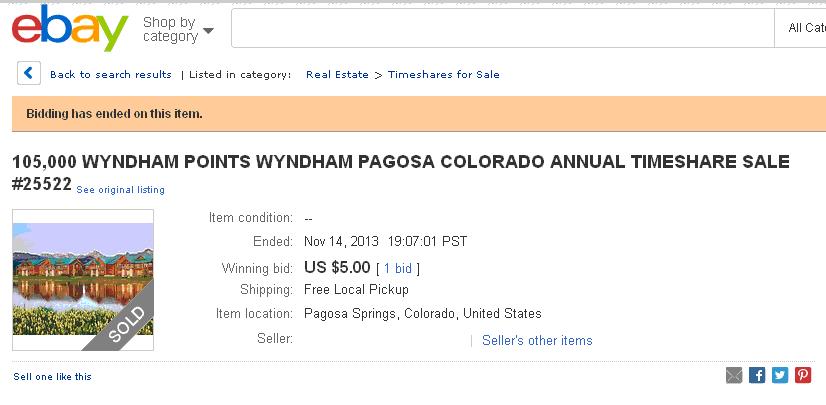
This is a COMPLETED ebay listing, where a legitimate seller accepted a bid of $5 dollars to someone willing to take over the ownership of his 105,000 point wyndham timeshare!
Why is this important? Well if you search some of the "upfront fee" sites mentioned above, It took all of 30 seconds to search for other Wyndham Pagosa timeshares currently for sale on a number of them...here are two great examples:

This particular one was actually for LESS than the Ebay 105,000 annual points.

This one was actually for the same number of points at 105k annually.
And for comparison sake so folks can't say I'm being unfair...these to the 3 current Pagosa Timeshares for sale on TUG, if you note they are all for sale for a single dollar:

So, you should just ask yourself, if you were a buyer and saw these 4 items, which one would you buy? More importantly, if you were looking to sell and saw 3 other folks selling the same thing for $1, would you really pay hundreds of dollars to list yours for $20,000 more? I think even the most skeptical of folks can answer that question with certainty.
You just made all that up using a special example Timeshare!
Actually I just randomly chose the first timeshare that popped up in the completed listings on Ebay at the time I was writing this article, however I urge....no I demand that you try this for yourself using your own timeshare as an example and see if you come up with a different result!
Sure there are some timeshares that have more residual resale value than others (Disney/Marriott/Hilton are good examples)...it just further reinforces the idea that you MUST RESEARCH the resale market and see what your timeshare is selling for. It doesn't take anything more than simple math and logic to see that if other owners are giving away the timeshare you are trying to sell, you simply aren't going to get anywhere near what you paid for it new trying to sell it!
The Final Word on Selling a Timeshare!
Selling a Timeshare flat out sucks. Its not going to be a fun or quick process for you, and you are going to encounter someone who is going to pitch you an offer that sounds too good to be true. You can either believe it and fork over some money, or listen to that ember of skepticism in your mind and know you are about to throw good money after bad!
Fact is, if you are confronted with an upfront fee, or you are suggested/urged/prompted/whatever towards an upfront fee company...this should be your first immediate red flag to run in the opposite direction.
You CAN sell your timeshare yourself for little to no cost to you, TUG has proven that for 20 years now. There are also LEGITIMATE options for folks to sell your timeshare for you, however in EACH of those cases just as with selling or buying any other piece of real estate, those legitimate folks work take their commission AFTER THE SALE.
If you have more questions or want to search topics, be sure to register on our Timeshare Online Discussion Forums where tens of thousands of Owners and Experts ask and answer all Timeshare related questions! Registration and participation on the forums is 100% free!
View and discuss this article here on the free TUG Timeshare owner Discussion forums!
 Access to Ratings & Reviews of more than 5000 Timeshare resorts all over the world!
 The TUGBBS online community forums consists of tens of thousands other timeshare owners and is the first, largest and most informative online Timeshare Forum on the internet!
 The TUG Timeshare Marketplace is one of the largest and most visited timeshare classified ad sites on the internet with Millions of dollars in completed listings and thousands of current ads posted by owners!
 TUG Advice is probably the most helpful section of the site for new buyers/sellers just getting into timesharing.